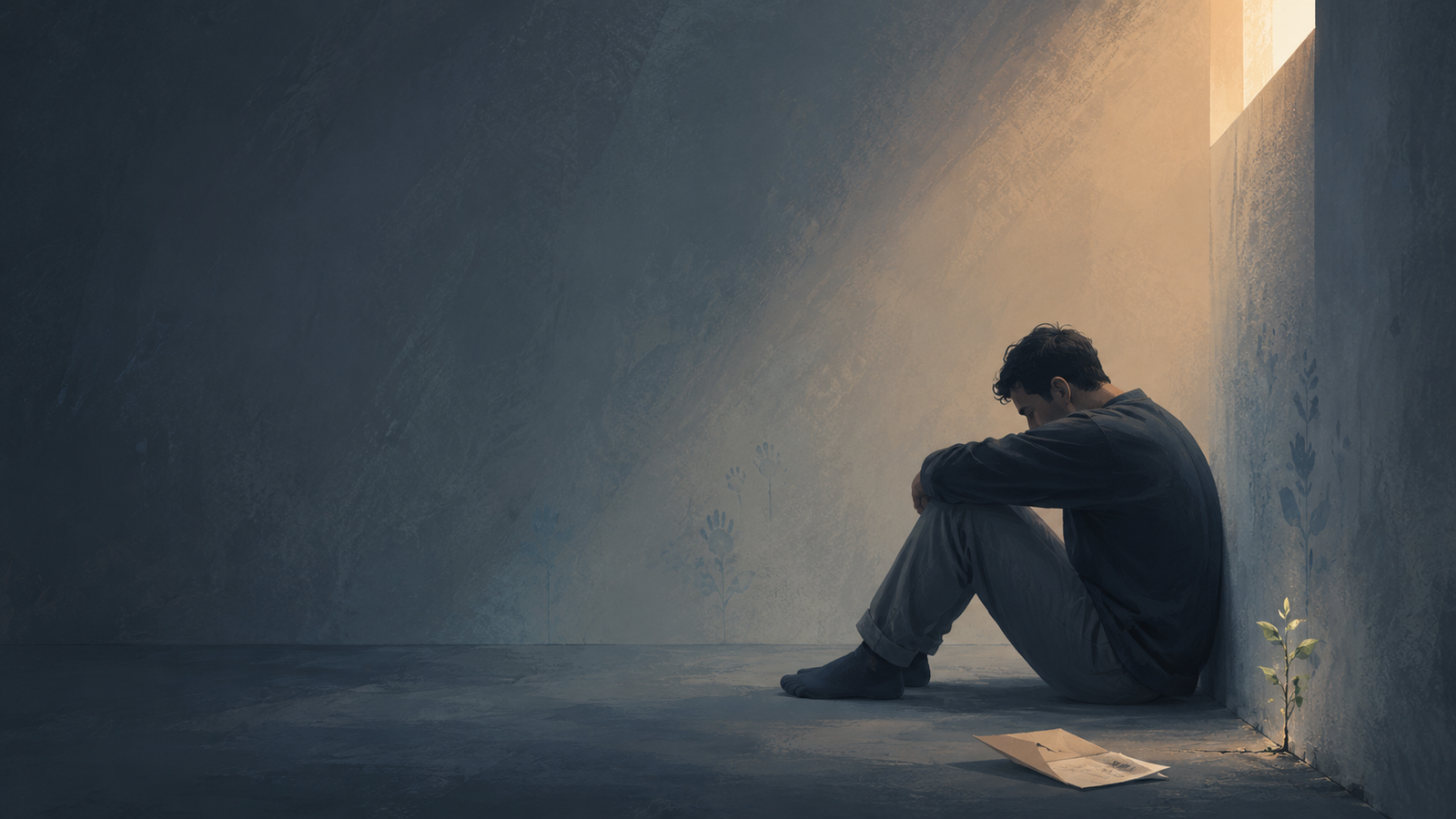
Published during Mental Health Awareness Month | A human-centered look at isolation, trauma, and the stories that deserve to be told.
Human beings are not built for silence. Not the kind that is imposed, locked in, and stripped of choice.
Yet across carceral systems in the United States, prolonged isolation — through solitary confinement, restricted housing units, and severely limited contact with family — remains a widespread reality. For the people who experience it, and for the families waiting on the outside, the damage runs deep. It touches the mind, the self, the spirit, and the bonds that hold people together.
This post examines what isolation inside incarceration actually does — psychologically, emotionally, and relationally — and why these stories matter, not as statistics, but as human experiences that deserve honest, careful attention.
What Is Solitary Confinement — And How Common Is It?
Solitary confinement, often called ""the hole,"" restrictive housing, or administrative segregation, typically involves confining a person to a small cell — often 6 by 9 feet — for 22 to 24 hours a day, with little to no meaningful human contact.
According to research from the American Civil Liberties Union and various correctional studies:
- On any given day, an estimated 80,000 to 100,000 people are held in some form of isolated confinement in U.S. prisons and jails.
- Stays can range from days to decades — far beyond what any mental health professional would consider humane.
- People with pre-existing mental health conditions are disproportionately placed in solitary, despite the well-documented risk of psychological deterioration.
Solitary confinement is not a rare or edge-case practice. It is embedded in how many facilities operate — often as punishment, sometimes as ""protection,"" and frequently without adequate oversight or time limits.
The Mind Under Isolation: What the Research Shows
The mental health effects of solitary confinement are not speculative. They are documented, consistent, and severe.
Sensory Deprivation and Cognitive Decline
The human brain requires stimulation, connection, and variety to function well. When those inputs are removed, the brain begins to struggle in measurable ways.
People who have experienced prolonged isolation commonly report:
- Hallucinations — visual, auditory, and tactile
- Paranoia and hyper-vigilance
- Severe anxiety and panic attacks
- Cognitive fog and difficulty concentrating
- Memory loss
- Difficulty processing language or completing sentences
Dr. Stuart Grassian, a psychiatrist who spent decades studying solitary confinement, identified a specific psychiatric syndrome — now often called SHU Syndrome (Secure Housing Unit Syndrome) — characterized by hypersensitivity to stimuli, perceptual distortions, cognitive difficulties, and intense anxiety. His findings, replicated by researchers across institutions, confirm what survivors have said for years: isolation does not just feel like punishment. It rewires the brain.
Depression, Suicidality, and Self-Harm
The rates of depression, self-harm, and suicide in solitary confinement are staggering.
- Studies show that people in solitary are significantly more likely to die by suicide than those in general population housing.
- Self-harm behaviors — including cutting, banging heads against walls, and refusing food — are far more prevalent in isolation units.
- The absence of meaningful human contact removes one of the most fundamental buffers against despair: the presence of another person.
Isolation does not just harm. In too many cases, it kills.
The Loss of Identity and Self
Beyond clinical symptoms, isolation strips something harder to measure but no less real: the sense of self.
People are social beings. We understand who we are, in large part, through our relationships — through being seen, heard, responded to, and valued. When all of that is removed, identity itself becomes fragile.
Survivors of long-term solitary confinement describe experiences of:
- Feeling like they were ""disappearing""
- Losing track of time, days, and even their own name
- Becoming unable to distinguish real memories from imagined ones
- Feeling permanently altered — like the person who entered isolation was not the same person who left
This is not metaphor. This is the lived psychological reality of isolation in incarceration.
Family Separation: The Invisible Extension of Isolation
Solitary confinement intensifies an experience that already defines incarceration for most people: separation from family.
Even outside of solitary, incarceration severs bonds in profound and lasting ways. Phone calls are expensive. Visitation is limited, logistically difficult, and often emotionally painful. Letters take weeks. Children grow up during the years their parent is away. Relationships fracture under the weight of distance, time, and shame.
For people in solitary, that separation becomes near-total. Contact with family is restricted or eliminated. The voice of a child, the presence of a partner, the comfort of a parent's words — all of it disappears.
What Families Experience
The mental health burden does not stay behind prison walls. It radiates outward.
Families of incarcerated loved ones — particularly those in solitary — frequently experience:
- Chronic anxiety about their loved one's safety and mental state
- Grief that does not fit neatly into social categories (their person is alive, but unreachable)
- Shame and stigma that isolates them from their own communities
- Financial strain from phone costs, travel, and lost household income
- Helplessness — knowing something is wrong and having no power to intervene
Children whose parents are incarcerated are at significantly higher risk for depression, anxiety, behavioral challenges, and educational disruption. The trauma of separation, compounded by stigma and silence, can follow them for decades.
The isolation of incarceration does not end at the cell door. It stretches into living rooms, classrooms, and communities.
Shame, Silence, and the Stigma That Compounds the Wound
One of the most painful dimensions of mental health and incarceration is how thoroughly shame operates to keep people silent.
Incarcerated people are often told — explicitly or implicitly — that their suffering is deserved. That what they feel does not matter. That asking for help is weakness. That mental health struggles are something to hide, not address.
On the outside, families carry their own shame. Many don't tell coworkers, neighbors, or even close friends that their loved one is incarcerated. They navigate grief and fear without community support, because the stigma of incarceration extends to everyone touched by it.
This silence does not protect anyone. It isolates further. It makes healing harder. And it makes it easier for systems to continue operating without scrutiny, because the people most affected have been conditioned to stay quiet.
Shame thrives in silence. Story is one of the most powerful tools against it.
Reentry: When the Walls Come Down, But the Damage Remains
For people who eventually leave incarceration — and the vast majority do — the mental health effects of isolation do not automatically resolve when the cell door opens.
Research on reentry consistently shows that people who experienced solitary confinement face:
- Greater difficulty reintegrating into social environments
- Heightened startle responses and difficulty tolerating noise or crowds
- Interpersonal challenges — struggling to maintain eye contact, conversation, and emotional attunement
- Higher rates of homelessness, unemployment, and re-incarceration — not because of character, but because of untreated trauma and inadequate support
The system often prepares people for release with little to no mental health support. People who spent years in near-total isolation are expected to re-enter complex social environments without tools, treatment, or transition.
This is not a failure of individuals. It is a failure of systems.
Why These Stories Matter — And How They Should Be Told
Data matters. Policy matters. Advocacy matters.
But stories — told honestly, carefully, and with dignity — have the capacity to do something that statistics alone cannot: they make the human being visible.
When we reduce people in solitary to a charge, a sentence, or a risk classification, we make it easier to accept their suffering without question. When we tell the fuller story — of who they were before, who they are inside, what they carry, what they hope for — we invite a different kind of thinking.
Accountability and dignity are not opposites. A person can be responsible for harm and still be worthy of humane treatment. A person can be in a cell and still be fully human. A family can be impacted by harm and still deserve care and support.
Telling these stories is not about defending every action. It is about insisting that the full humanity of every person remains visible — because when it does, it becomes harder to accept conditions that dehumanize.
What Thoughtful Storytelling Around Isolation and Mental Health Looks Like
- Center the person, not just the system. Policy matters, but so does the individual experience behind it.
- Use language that preserves dignity. Words like ""inmate"" or ""offender"" flatten identity. Words like ""person,"" ""human being,"" and ""someone's parent"" restore it.
- Acknowledge complexity. People can have caused harm and still deserve humane treatment. Both things are true.
- Make space for families. Their grief, fear, and resilience are part of the story.
- Resist the urge to sensationalize. The reality is already powerful. It does not need to be dramatized to matter.
- Pair honesty with hope. Even the darkest stories can carry the possibility of healing, connection, and change.
A Note on Hope
Isolation is devastating. That is the honest truth.
But it is not the only truth.
People survive solitary confinement. They write poetry on napkins. They do push-ups to stay present in their bodies. They hold onto the memory of people they love. They find ways, however small, to preserve something of themselves in conditions designed to erase it.
Families hold on. They make calls that cost too much. They drive hours to sit across a glass partition for forty-five minutes. They write letters into silence and hope something comes back.
Communities advocate, organize, and tell stories — because they know that what happens inside those walls is not separate from what happens outside them.
Hope is not naive. It is an act of resistance. And it is something that every person affected by incarceration — whether behind walls or waiting at home — deserves to hold onto.
Resources for Those Affected by Incarceration and Mental Health
If you or someone you love is navigating the mental health effects of incarceration, family separation, or reentry, you are not alone. The following organizations offer support, information, and community:
- National Alliance on Mental Illness (NAMI): nami.org | Helpline: 1-800-950-NAMI
- Prison Policy Initiative: prisonpolicy.org — research and advocacy on incarceration
- Vera Institute of Justice: vera.org — reform research and policy resources
- Family & Corrections Network: fcnetwork.org — support for families of incarcerated people
- 988 Suicide & Crisis Lifeline: Call or text 988 — available 24/7
Share This Story. It Matters.
If this post resonated with you — if you have a loved one who has experienced solitary confinement, if you work in mental health or advocacy, if you simply believe that context matters — please share it.
Stories change minds when arguments cannot. The more people who understand what isolation in incarceration actually does to human beings, the harder it becomes to accept it as normal, necessary, or inevitable.
Every sentence has a story. Every person in that sentence has a name, a family, and a humanity worth protecting.
Share this post. Start the conversation. And if you are living this story yourself — know that your experience deserves to be heard, not hidden.
This content is intended for educational and awareness purposes. It is written with a trauma-informed, human-centered perspective in recognition of Mental Health Awareness Month and the ongoing need for honest, dignified conversations about incarceration and mental health."
0 Comments