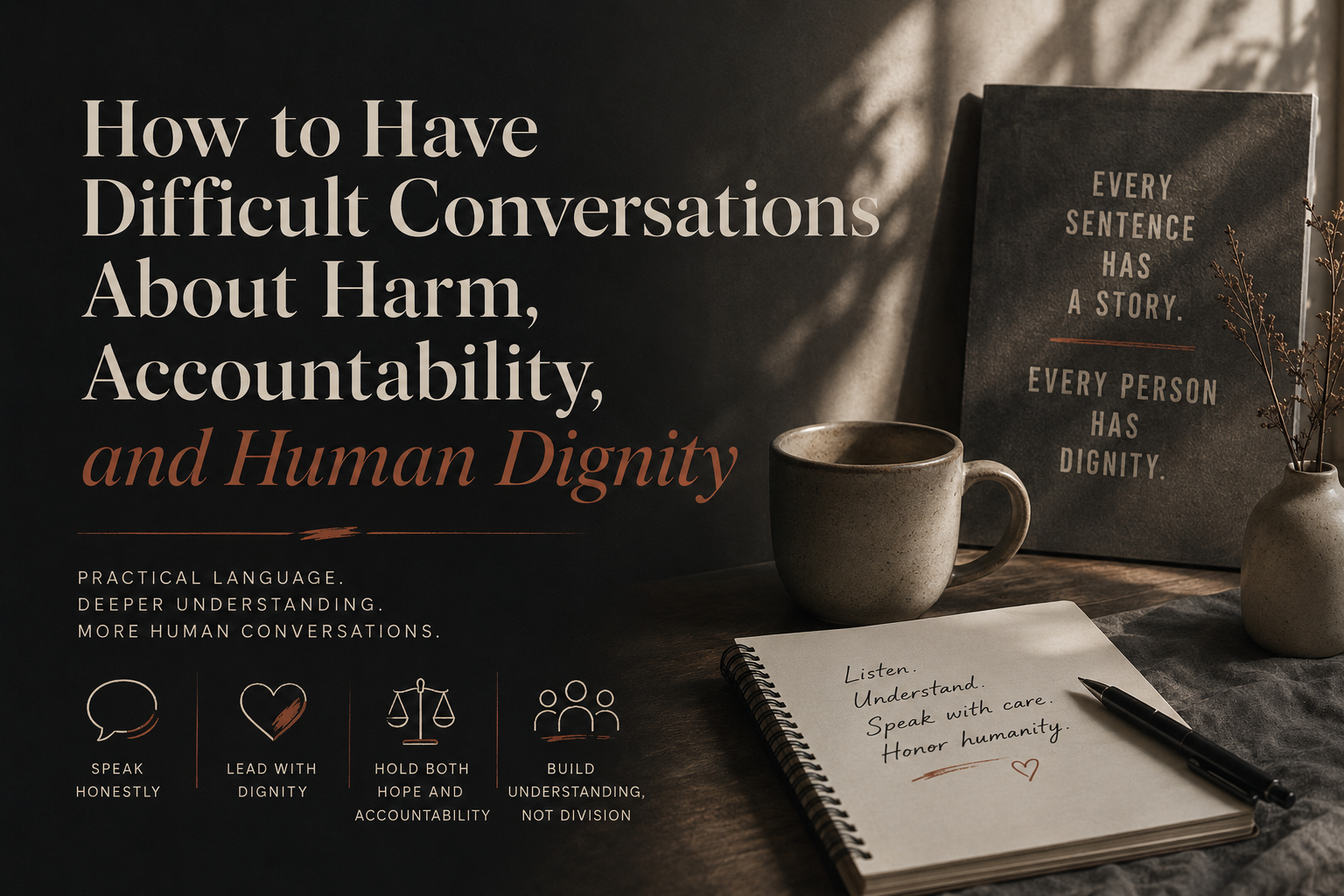
Holding Both: How to Talk About Harm Without Erasing the Person
Some conversations carry too much at once. Pain and anger. Responsibility and fear. Grief, loyalty, and a stubborn hope that things can still change. When the subject is incarceration, violence, addiction, or harm inside a family, even the words we reach for can feel like they're taking a side.
People worry that talking about someone's dignity will make the harm smaller than it was. Others worry that naming the harm will freeze a person inside the worst thing they ever did. And so the conversation tips into an argument — over who deserves compassion, whose pain counts most, whether accountability and dignity can sit in the same room.
They can.
Seeing someone's humanity doesn't erase what they did. Naming harm doesn't mean giving up on them. Accountability isn't the same as humiliation, and compassion isn't the same as looking away.
The point of a hard conversation isn't always to agree. Often it's simpler than that: to tell the truth, to listen well, and to not add new harm to the old. This guide is about how to do that.
1. Person-first language doesn't shrink the harm
Person-first language starts from one idea: a person is more than a single action, diagnosis, or line on a record. Instead of letting a label stand in for the whole human being, it describes the situation without pretending the description is the whole story.
- A person who is incarcerated, not an inmate
- A person who caused harm, not a monster
- A person with a substance-use disorder, not an addict
- A person coming home from prison, not an ex-con
- A person who survived violence, rather than only "a victim"
None of this hides what happened. "A person who caused serious harm" still names the harm plainly. What changes is that the harm stops being the person's permanent name.
This can feel uncomfortable, especially when a harsh label seems like the only way to show you take the harm seriously. But accuracy and dignity aren't enemies.
You can say, He caused serious harm, and the people he hurt deserve to have that named. And you can also say, He's still a person — capable of reflection, responsibility, and change. Both are true.
Person-first language doesn't ask anyone to pretend actions don't matter. It just refuses to confuse one action with the entire worth of a life.
2. Name harm plainly, without making it someone's whole identity
Refusing dehumanizing labels isn't the same as going vague — and soft, sanitized language can be its own kind of dishonesty.
"Mistakes were made." "Things happened." "It was a difficult situation." Phrases like these dodge discomfort by quietly erasing responsibility. When harm is real, the people who carry it shouldn't have to hear it described like a change in the weather.
The skill is naming the behavior without turning the behavior into a forever-identity. Compare:
He is dangerous and evil.
He did something that caused serious and lasting harm.
Or:
She destroys everyone around her.
Her choices damaged real relationships, and rebuilding trust will take steady change over time.
The first line in each pair is a verdict on the whole person. The second names the action and what it cost.
Clear language lets you keep four separate questions separate: What happened? Who was hurt? Who's responsible? And what would accountability or repair actually require? Those questions get you further than deciding which word should follow someone for the rest of their life.
So be specific about behavior and impact. What he said was a threat. Her decision left the family in financial trouble. The violence caused trauma that didn't end when the incident did. He's taken responsibility for his part — and responsibility doesn't undo the consequences. That kind of language neither excuses nor exaggerates. It just keeps the conversation honest about what actually happened.
3. When someone says "actions have consequences"
"Actions have consequences" usually arrives like a closing statement. And it's true — actions do have consequences. But consequences aren't automatically fair, or proportionate, or useful, or permanent.
When the phrase gets used to shut down any talk of dignity, rehabilitation, sentencing, or a second chance, you don't have to argue with the basic point. You can widen it.
I agree — actions have consequences. I think we're also allowed to ask whether they're proportionate, and whether they actually create safety, accountability, or repair.
Accountability matters to me too. I just don't think it requires us to stop seeing someone as a person.
The consequences of harm usually reach a lot of people — survivors, families, kids, whole communities. That's exactly why it's worth being careful about what those consequences are supposed to accomplish.
None of that lets anyone off the hook. A consequence can do different jobs: protect people, mark the seriousness of the harm, discourage it from happening again, push someone toward change, or open a path to repair. Sometimes it does several at once. Sometimes it does none of them well.
So it's fair to ask: Does this consequence address the harm? Does it keep people safe? Does it give the person a way to demonstrate accountability? Is there any path back toward repair? Is anyone else being harmed for no real reason? Is it still doing its job years later?
"Actions have consequences" is a good place to start a conversation about accountability. It's a poor place to end one.
4. Hold hope and accountability at the same time
Hope without accountability slides into denial. Accountability without hope hardens into a life sentence of contempt.
Holding both means refusing two tidy, incomplete stories — nothing he did should define him, and what he did is the only thing about him that matters. The truer version is less comfortable: what happened matters, the impact matters, responsibility matters, and the possibility that a person can grow matters too.
Hope doesn't promise that someone will change. It doesn't require trust, reconciliation, forgiveness, release, or a restored relationship. It only leaves room for the idea that a human being isn't frozen forever in their worst moment.
And accountability is bigger than punishment. It can look like owning what happened without minimizing it, listening to how it landed on other people, accepting fair consequences, repairing what can be repaired, changing the patterns that caused the harm, respecting boundaries, and showing that change over time rather than just describing it.
Someone can be accountable even when full repair isn't possible. Some losses don't come back. Some relationships won't be rebuilt. Some people will never want contact again — and that boundary deserves respect, not negotiation.
Growth doesn't erase the history. But the history doesn't have to cancel the possibility of growth.
5. Three phrases that keep you grounded
When feelings run high, people answer too fast — defending, accusing, interrupting, reaching for the sharpest version of what they mean. A few phrases can slow things down.
"I want to make sure I understand what you're saying." This buys a little space before you respond. It isn't agreement; it's a decision to actually hear the other person. You can follow it with, Are you worried that talking about dignity will make the people who were hurt feel forgotten? Reflecting the concern back often shows the disagreement is narrower than it looked.
"Two things can be true at once." Useful when the room collapses into either/or. Two things can be true at once: the harm was serious, and the person who caused it is still human. Or: We can respect a survivor's boundaries and still believe people can change.
"I don't want to talk past the harm." This tells the other person you're not trying to slip around the hard part. I don't want to talk past the harm. I want to talk about what accountability can look like without treating anyone as disposable.
Grounding language works because it makes your intention legible. It reminds everyone the conversation isn't a contest over who can land the heaviest moral accusation.
6. Disagree without escalating
Not every disagreement has to become a standoff. Escalation usually starts when someone feels their values or experience are being waved away. They push harder because it sounds like you're not just disagreeing — you're questioning whether they care about harm at all.
Before you answer, ask yourself what the other person is trying to protect. It might be the dignity of someone who was hurt. The chance that a person can be rehabilitated. Their family. Their own safety. Their sense of fairness. A boundary they fought hard to set. You don't have to land on their conclusion to respond to the real concern underneath it.
Instead of "You clearly don't think people can change," try: It sounds like you're worried that talking about change puts pressure on people to forgive or trust again. Instead of "You only care about punishment," try: I think we might just mean different things by accountability.
A few more that help:
- I get why that wording matters to you.
- I see it differently, but I'm not trying to dismiss what you're saying.
- We might not agree on the outcome, but I think we both want to prevent more harm.
- I need a second before I answer — I don't want to say this carelessly.
Disagreement goes better when people feel they were actually heard, even when nobody changes their mind.
7. Support someone without trying to rescue them
When someone you care about is living through incarceration, separation, trauma, or the aftermath of harm, it's hard to know what help even looks like.
Support usually isn't fixing it. Most of this can't be fixed in one conversation, and promising to fix everything tends to create false hope — or quietly sign you up for a job you can't actually hold. Support can sound a lot smaller, and matter a lot more:
I can't change what happened, but I can listen.
I don't know how to fix this, but you don't have to carry it by yourself tonight.
What would actually feel helpful right now?
Do you want me to just listen, help you think it through, or give you some room?
That last kind of question matters because it doesn't assume you already know what the person needs.
And supporting someone doesn't mean abandoning your own limits. Boundaries are part of care that lasts. You can say, I care about you, and I don't have it in me for a long talk tonight — can I check in tomorrow? Or, I want to support you, but I'm not the right person to mediate this.
Care with no limits curdles into resentment and burnout. Limits with no care feel like being dropped. Honest support holds both.
8. Share context without oversharing
Context helps. It can correct misinformation, push back on lazy assumptions, and show that a person's story didn't begin with one harmful act or one court date.
But context has to be handled with care. Explaining someone's background shouldn't slide into excusing the harm. Telling their story shouldn't trample their privacy. And advocacy never requires putting every painful detail on display.
Before you share, run through a few questions. Is this mine to share? Does the person know where it might end up? Is this detail actually necessary? Could it put someone at risk — a survivor, a child, a family member who never agreed to be part of the story? Am I sharing this to build understanding, or to get a reaction? Would the person recognize themselves, with dignity, in the way I'm telling it?
A simple shape tends to work:
Name the context. He grew up around a lot of instability and violence.
Don't let it stand in for an excuse. That doesn't erase the harm he later caused.
Say why it still matters. But it points to the patterns that have to be addressed if we want to prevent more harm.
Context isn't the opposite of accountability. Understanding why something happened is often how you figure out what real change — and real prevention — would take.
9. Ask better questions, and leave room for "no"
People ask intrusive questions for all kinds of reasons — curiosity, discomfort, a genuine attempt to make sense of something hard. But nobody is owed another person's trauma, record, or private grief.
Questions like What exactly did he do? Were you there? Why did she stay? Do you forgive him? How can your family still support her? Are you sure he's really changed? can land as pressure even when no cruelty is intended. They can push someone to defend a relationship, relive something painful, or hand over information that was never only theirs to give.
Better questions leave the control with the person answering:
- Is there anything you'd want me to understand?
- What part of this feels most important to you?
- Would it help to talk about it, or would you rather not?
- Are there words you'd prefer I use?
- Is this something I can share, or should I keep it to myself?
And you can say the quiet part out loud: You don't have to answer this — but is there a way I can support you? That one sentence can change the whole temperature of a conversation.
10. A quick check before a hard conversation
Before you walk into one of these, it's worth slowing down for a moment and asking yourself a few things.
- Am I naming the harm clearly, instead of hiding it behind vague language?
- Am I reducing anyone to a label — the person who caused harm, or the person who was hurt? Nobody is only an offender, a victim, an addict, or a case number.
- Am I confusing dignity with trust? Everyone has dignity. Trust, access, reconciliation, and forgiveness are separate things, and they may have to be earned — or may never be given.
- Am I pressuring someone to forgive, explain, disclose, or reconcile? People who've been harmed get to have boundaries. They don't owe anyone a particular feeling.
- Am I leaving room for accountability? Compassion doesn't mean pretending nothing happened.
- Am I leaving room for growth? A person's worst act can stay part of their history without becoming the whole truth about their future.
- Is this story mine to tell? Protect the privacy of everyone involved — especially kids, survivors, and anyone who never agreed to be talked about.
- Am I listening to understand, or just waiting to talk?
- Do I need to pause? Continuing later beats saying something careless now.
- What is this conversation actually for? Understanding, a boundary, a correction, support, a real talk about accountability — naming the purpose keeps it from becoming an argument about everything at once.
Dignity is not the absence of accountability
A lot of the hardest conversations get stuck on one false assumption: that dignity and accountability are on opposite sides.
They aren't.
Dignity asks us to see the humanity of everyone in the story. Accountability asks us to tell the truth about what was done, who it hurt, who's responsible, and what change would take. A dignity-centered approach doesn't stay neutral about harm. It doesn't ask anyone to trust, forgive, reconcile, or stay somewhere unsafe. It doesn't promise that everyone changes. It just refuses to believe that safety or justice has to be bought with someone's humanity.
We can name harm without turning people into labels. We can honor the people who were hurt without using their pain to justify cruelty. We can support accountability and still ask whether a response is proportionate, useful, and humane. We can believe in growth without pretending it erases the past.
These conversations are never going to be fully comfortable. Maybe they shouldn't be. Harm deserves to be taken seriously, and human lives are too complicated for slogans.
But we can come to them with more clarity, more humility, and more care. We can tell the truth. We can respect the line someone has drawn. We can stay open to change.
Because a sentence isn't the whole story — and recognizing someone else's humanity has never once cost us our own.
0 Comments