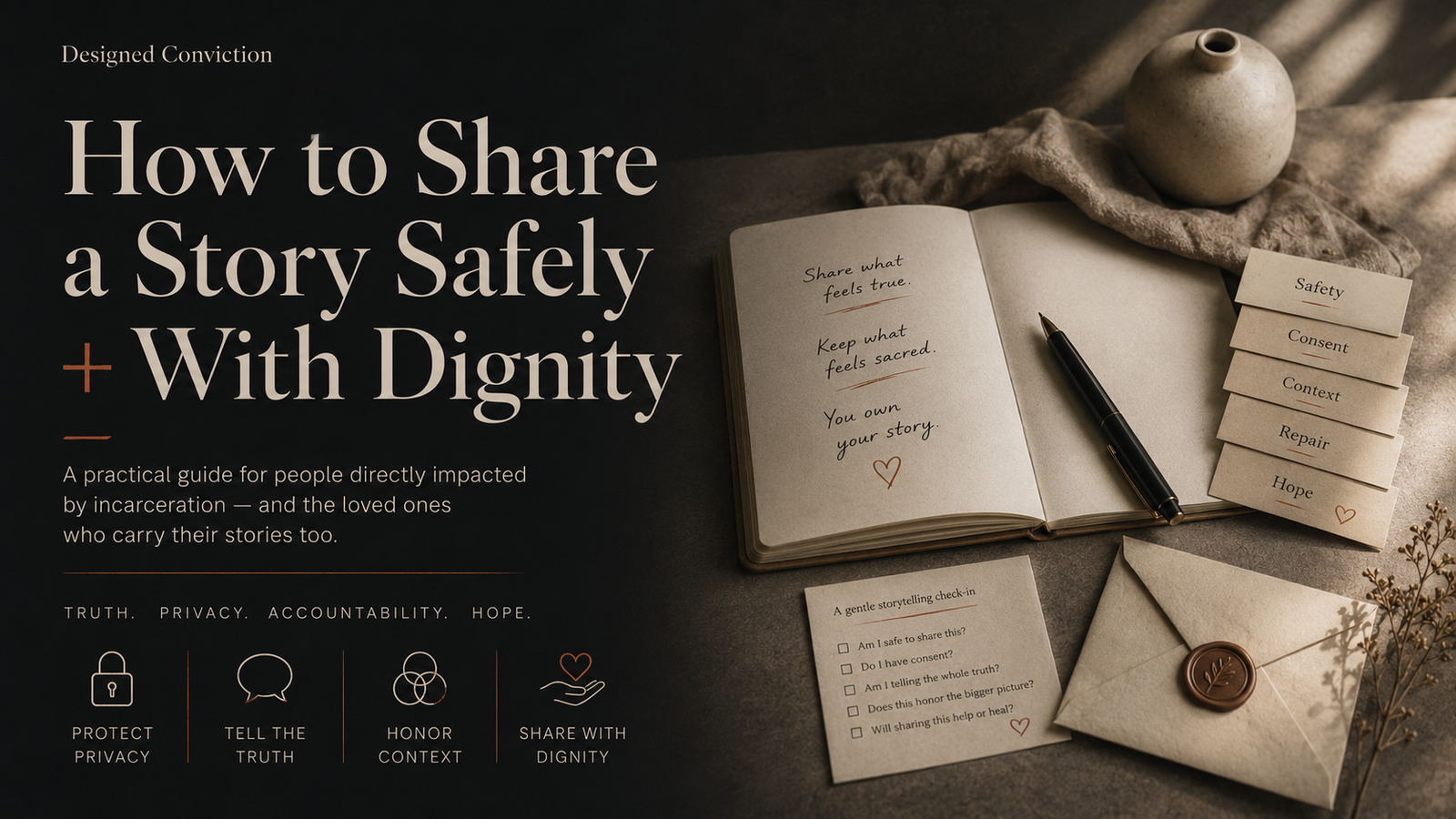
A practical guide for people directly impacted by incarceration — and the loved ones who carry their stories too.
Every Sentence Has a Story
Hope doesn’t excuse. Hope insists on change.
Welcome to a guide designed to help you share what matters most without oversharing, without fear, and without feeling judged. You’ll learn a clear framework, safety practices, and practical tools that honor truth and dignity.
What you’ll gain in this guide: clarity about what to share and what to keep private; language that holds accountability and hope; ready-to-use prompts and templates; and a safe process for submitting your story.
Welcome
Sharing a story about incarceration—whether it’s your own or about someone you love—can feel vulnerable. You may want to honor the truth, protect your loved one, avoid judgment, and still speak with dignity.
This guide exists to help you share what matters most without oversharing, without fear, and without feeling judged.
There is no “perfect” way to tell a story. You don’t owe the internet every detail.
Share only what feels safe, true, and yours.
In this guide, you’ll find:
- A simple framework for telling stories with accountability and hope
- A privacy and safety checklist
- Consent guidance (especially for loved ones writing about someone incarcerated)
- Examples you can model (loved one + formerly incarcerated + advocate)
- Prompts to get unstuck
- Copy-paste templates you can use immediately
- What happens after you submit (review process + publication options)
A note on tone
We are not here for drama, sensational details, or “hot takes.” We are here for truth, accountability, context, growth, and second chances—without erasing harm.
Disclaimer: This guide is educational and not legal advice.
Start Here (Quick Win) — Read This in 3 Minutes: The Point of the Story
A powerful story doesn’t need everything. It needs what’s true and what’s human.
- A sentence isn’t the whole story.
- Context matters.
- People grow.
- Redemption is possible.
The best stories usually include:
- What happened (without graphic detail)
- What you (or your loved one) take responsibility for
- The context that shaped the path (without using it as an excuse)
- What changed
- What repair and accountability look like now
If you only read one section, read the next. Safety comes first.
Use the next section’s safety rules as your pre-share checklist. They will help you avoid oversharing, protect identities, and stay grounded. Then return to this quick-win outline to shape a story that balances accountability and hope.
Safe Sharing Rules — Before You Share: 10 Safety Rules
- Protect identities when needed. Use a first name only, initials, or a pseudonym. Avoid workplace names, small-town identifiers, unit numbers, or anything searchable.
- Avoid case specifics. You can share transformation without sharing evidence, timelines, allegations, names, or details that create risk.
- Be careful with children’s details. No school names, addresses, custody specifics, schedules, or identifying photos/information.
- Don’t share private or sensitive data. Addresses, inmate IDs, phone numbers, emails, legal documents, medical records—keep these private.
- Don’t “out” someone’s story. If you are writing about a loved one, try to get consent—or write in a way that protects them if consent isn’t possible.
- Avoid naming victims or witnesses. Focus on your experience, accountability, and growth without exposing or identifying others.
- Use “I” language. Share what you experienced, learned, and witnessed. Avoid claims you can’t prove.
- Stay away from accusations. Avoid blaming specific people, institutions, or listing “what they did” in detail. You can speak about harm without creating new harm.
- If your body feels unsafe, pause. Anxiety, shaking, tightness, nausea—your nervous system is giving you a signal. Stop and come back later.
- Write for future you. If someone Googles this in two years… will you still feel okay?
Treat this list as your personal safety gate. If any rule raises a concern, adjust your draft before you share. Protecting privacy and dignity protects you and the people you love.
The Four-Part Story Framework
Use this framework to keep your story grounded, honest, and dignified.
1) Accountability: what I own
- What choices did I make?
- What harm happened (without graphic detail)?
- What responsibility do I take?
2) Context: what shaped the path
Context is not an excuse. It is the truth around the truth.
- What pressures, environment, patterns, or pain shaped decisions?
- What was normalized that shouldn’t have been?
- What did I not understand then that I understand now?
3) Growth: what changed
- What did I learn?
- What did I stop denying?
- What is different in my thinking, behavior, and values today?
4) Repair: how I make it right
- How am I rebuilding trust (if that’s possible)?
- What boundaries, supports, and practices keep me accountable?
- How am I giving back, learning, or making amends?
Reminder
- Accountability keeps the story credible.
- Context makes it human.
- Growth makes it hopeful.
- Repair makes it real.
Workbook: Decide What to Share
Circle what feels safe
Use the sections below to mark what’s comfortable, what needs caution, and what to keep private. Your boundaries can change over time—revisit as needed.
Comfortable to share (usually):
- First name or pseudonym
- Emotions and impact on family
- Lessons learned
- What changed
- Values, goals, and accountability practices
- Boundaries and support systems
Share only if you’re sure:
- Exact dates and locations
- Specific facility details
- Full legal names
- “Proof” or documents
- Information involving minors
- Anything that identifies a victim/witness
Recommended to keep private:
- Legal paperwork
- Medical/mental health records
- Addresses, work locations, school names
- Names and details that can be searched
5-Sentence Story Exercise (5 minutes)
Write five sentences using the framework:
- What happened (simple and non-graphic).
- What I own.
- The context that shaped it.
- What changed.
- What repair looks like now.
Consent + Writing About Someone Else
If you are a loved one writing about someone incarcerated:
You can honor your loved one’s story while protecting them.
Consent matters. If you have permission, great. If you don’t, you can still share your perspective—just avoid identifying details and avoid speaking as if you are them.
Safer options:
- Write from your experience: “This is what incarceration has done to our family…”
- Use general language: “Someone I love is incarcerated…”
- Include their words only with permission: “With their consent, I’m sharing a few lines they wrote…”
Avoid:
- Sharing anything that could cause them consequences inside
- Repeating sensitive details that belong to someone else
- Posting letters or private messages without permission
You don’t need to share everything to share something meaningful.
Examples (Loved One + Formerly Incarcerated + Advocate)
Example 1: Loved one perspective (good → better → best)
GOOD (too vague):
“My partner is in prison and people judge him. He deserves another chance.”
BETTER (adds boundaries):
“My partner is incarcerated. We’re living with the consequences, and I’m learning that love can include accountability and boundaries.”
BEST (accountability + context + growth + repair):
“My loved one is incarcerated, and our family lives with the consequences every day. I’m not here to excuse harm—I’m here to share what I’ve witnessed since: ownership, hard conversations, and a commitment to change. There’s context to the path that led here, but context isn’t a free pass. What gives me hope is growth—consistent effort and humility—and repair that looks like boundaries, honesty, and rebuilding trust slowly.”
Optional closing:
“Hope doesn’t erase consequences. Hope insists on change.”
Example 2: Formerly incarcerated (credible and human)
BEST (framework in action):
“I take responsibility for what I did. I caused harm, and I carry that. There is context to my choices—patterns, pressure, and pain I never faced—but I’m not sharing it as an excuse. I’m sharing it because change starts with telling the truth. What’s different now is how I live: accountability, support, and a commitment to do the hard work. Repair looks like consistent actions, not words—accepting consequences and choosing a different future than my past.”
Optional closing:
“Redemption isn’t a clean ending. It’s a daily practice.”
Example 3: Advocate/community voice (without debate)
“I advocate because I’ve seen what incarceration does to families—how it reshapes identity, finances, parenting, and hope. I’m not asking anyone to ignore harm. I’m asking us to hold two truths at once: accountability matters, and human dignity still matters. When we make room for context and growth, we make communities safer—not softer.”
Prompts (Pick One)
For formerly incarcerated:
- “The moment I stopped blaming everyone else was…”
- “The hardest truth I had to face was…”
- “A pattern I’m breaking is…”
- “Accountability looks like _ in my life today.”
- “A second chance means _ to me because…”
For loved ones:
- “I never expected incarceration to teach me…”
- “What I want people to understand about our family is…”
- “Hope looks like _ in our house.”
- “A boundary that helped me breathe again was…”
- “What I’ve witnessed change is…”
For advocates/supporters:
- “I advocate because…”
- “Accountability and dignity can exist together when…”
- “What I learned after listening to families is…”
Tip: Don’t write everything. Write the part you can tell safely.
Copy-Paste Templates
Template 1: Formerly incarcerated (Accountability + Hope)
“I take responsibility for what I did. I’m not proud of it, and I don’t minimize the harm. There is context to my choices, but I’m not sharing it as an excuse. I’m sharing it because change starts with truth. What’s different now is _ . Repair looks like . Redemption, to me, means __.”
Template 2: Loved one (with boundaries)
“My loved one is incarcerated, and our family lives with the consequences every day. I’m not here to excuse harm—I’m here to share what accountability and growth can look like over time. For us, hope isn’t denial. It’s commitment: _ . If you’re carrying this too, you’re not alone.”
Template 3: Advocate/community voice
“I advocate because I’ve seen the human side of incarceration. Accountability matters. So does dignity. When we make room for context and growth, we make change more possible—and communities stronger.”
What Happens Next
Thank you for reading
If you’re here, it means you care about how stories are told—with truth, dignity, and respect for the people living them.
Every Sentence Has a Story is a space created for stories that hold more than a label.
Stories that include accountability, context, growth, and the possibility of change.
When you’re ready
You’re invited to explore the platform and decide what feels right for you:
Visit: www.everysentencehasastory.com
There you can:
- Learn what kinds of stories we’re looking for
- Read how we approach storytelling with dignity
- Explore the submission options and next steps
- Find resources and education for families, advocates, and directly impacted people
No pressure. No urgency.
Just an open door—for whenever you’re ready.
Closing Invitation
You own your story
You decide what to share.
You decide what to keep private.
You decide the pace.
If you ever choose to share, your voice can help bring the public closer to the full human reality behind incarceration—not just a sentence, not just a headline, not just the worst moment.
Why it matters
When stories are told with accountability and context, they can do something powerful:
- Reduce shame
- Increase understanding
- Invite real reflection
- Make growth visible
- Help families feel less alone
If you want to help
You can help us highlight stories like yours—and stories like the ones you carry.
Visit: www.everysentencehasastory.com
Explore when you feel ready.
Share what feels true. Keep what feels sacred.
And remember: your story belongs to you.
Share this guide. Forward it or print it.
Want your loved one to receive resources like this in prison?
Add them to our mailed newsletter list.
Visit: www.designedconviction.com/every-sentence-has-a-story/free-resources-for-the-incarcerated
Every Sentence Has a Story
by Designed Conviction—storytelling for accountability, context, growth, and second chances.
0 Comments