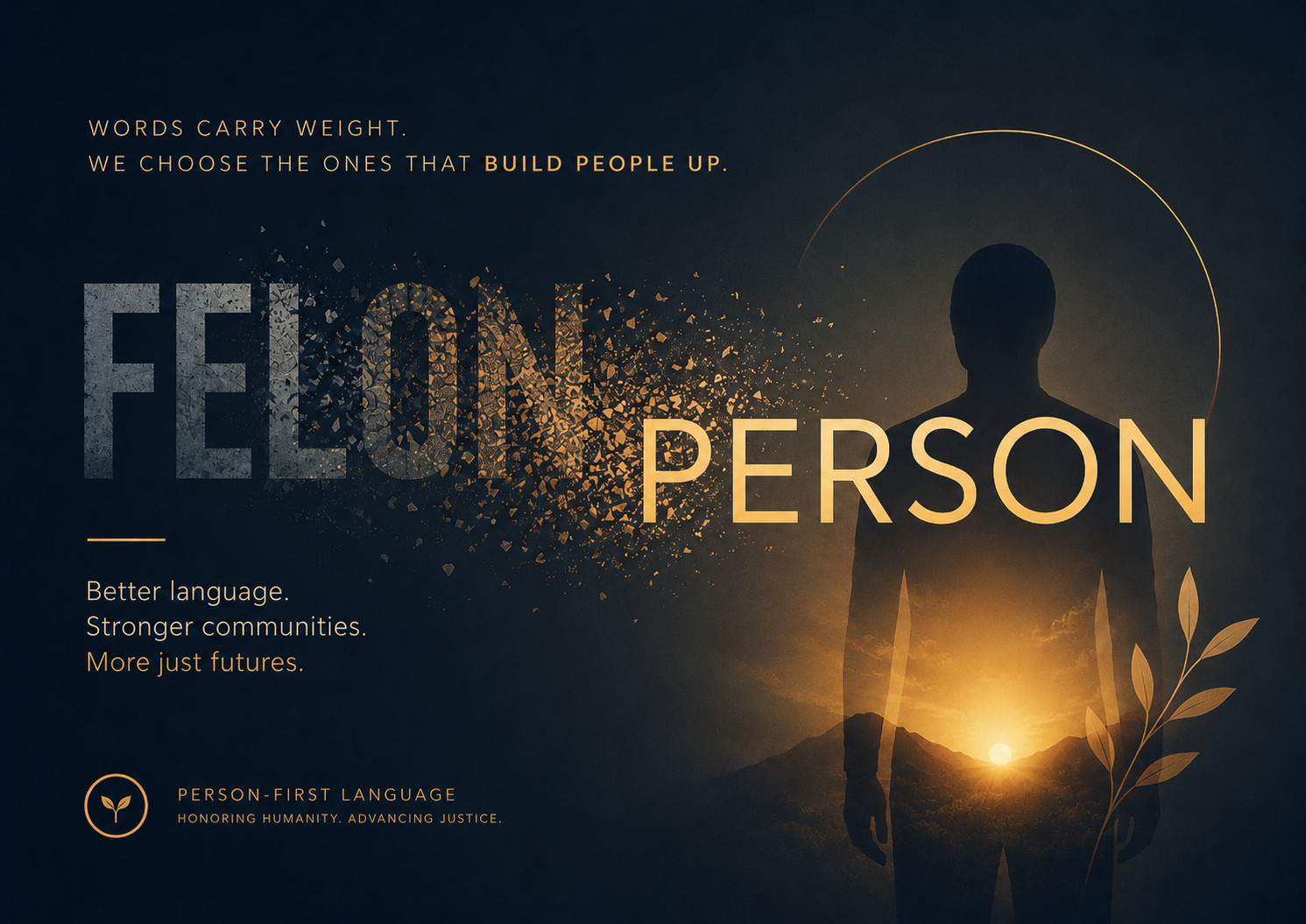
Words are not neutral. They never have been. The language we use to describe people — especially people who have been involved in the justice system — quietly shapes what the public believes those people deserve, who they are allowed to become, and whether they are seen as fully human at all.
This is not a conversation about political correctness. It is a conversation about accuracy, dignity, and what becomes possible when we choose language that reflects the full complexity of a human life.
The Weight of a Label
When someone is called a felon, that single word carries enormous weight. It does not describe a moment. It does not describe a choice made under specific circumstances, within a specific context, at a specific point in someone's life. It describes a person — entirely, permanently, and often without mercy.
The same is true of words like:
- Criminal
- Offender
- Convict
- Monster
- Inmate (when used as an identity rather than a circumstance)
These words do something subtle but powerful: they collapse a human being into a single data point. They take everything a person is — a parent, a child, a neighbor, someone with dreams and fears and a history that stretches far beyond one moment — and reduce them to their worst chapter.
And once a person is reduced that way in public language, it becomes much easier to justify treating them as less than human.
What Person-First Language Actually Does
Person-first language is a communication framework that places the person before their condition, status, or circumstance. It was originally developed in disability advocacy, where advocates pushed back against language like "the disabled" in favor of "person with a disability." The logic is simple: the condition does not define the whole person.
Applied to justice contexts, person-first language looks like this:
| Instead of... | Try... |
|---|---|
| Felon | Person with a felony conviction |
| Criminal | Person who was convicted of a crime |
| Inmate / Prisoner | Person who is incarcerated |
| Ex-con | Person who was formerly incarcerated |
| Offender | Person who caused harm / person involved in the justice system |
| Monster | — (no replacement — this word dehumanizes entirely) |
The difference is not just grammatical. It is philosophical. It is a statement about whether a human being is reducible to the worst thing that happened in their life — or whether they remain a person, with context, history, and the possibility of something more.
Why Language Shapes Public Perception
Research in social psychology has consistently shown that the words used to describe a group of people directly influence how that group is perceived and treated. This is called framing, and it operates largely beneath conscious awareness.
When media, politicians, and public conversations consistently use dehumanizing language to describe people with criminal records, several things happen:
- Public empathy decreases. When someone is called a monster, the brain's empathy response is literally suppressed. We are wired to extend empathy to humans, not to creatures or categories.
- Support for harsh policies increases. Studies have found that dehumanizing language makes people more likely to support punitive measures, regardless of whether those measures reduce harm.
- Reentry becomes harder. People who are formerly incarcerated face enormous barriers — housing, employment, relationships, community belonging. Those barriers are reinforced when public language signals that they are permanently defined by their record.
- Families are collaterally shamed. When a person is labeled a "criminal" or a "felon," that stigma does not stay with one person. It radiates outward to their children, partners, and families — people who may have caused no harm at all.
Language is infrastructure. It builds the social environment in which real policies and real consequences operate.
"But Doesn't Accountability Still Matter?"
Yes. Absolutely.
This is one of the most important clarifications in any conversation about person-first language and justice: choosing dignified language is not the same as minimizing harm. It does not mean pretending that harm did not happen. It does not mean excusing behavior or removing consequences.
It means this: a person can be fully accountable for what they did and still be more than what they did.
Those two things are not in conflict. Accountability and dignity can exist in the same sentence. In fact, meaningful accountability — the kind that actually leads to healing, repair, and change — is far more possible when a person is seen as human enough to be capable of growth.
Dehumanizing language does not make accountability more real. It just makes it easier to stop caring about outcomes.
The Storytelling Dimension
For advocates, journalists, educators, and storytellers working in justice-adjacent spaces, person-first language is more than a stylistic choice. It is an ethical one.
The stories we tell about people shape what the public believes is possible for those people. When someone's story is told through the lens of their worst moment — when that moment becomes their entire identity — it forecloses possibilities in the public imagination before a person even has a chance to demonstrate who else they are.
Consider two different ways to introduce the same person:
"A convicted felon from the south side of Chicago..."
versus
"A father and former construction worker who spent eight years incarcerated and has since..."
Both sentences may be factually accurate. But only one of them creates space for the reader to see a human being. Only one of them invites empathy. Only one of them opens a door.
Person-first language is the craft of opening doors.
Practical Guidance: How to Shift Your Language
If you are a writer, educator, advocate, or anyone who communicates about justice-involved people, here are practical steps to begin applying person-first language:
1. Audit Your Default Vocabulary
Make a list of the words you instinctively reach for when describing people in or after the justice system. Notice which words are labels and which words describe circumstances.
2. Lead With the Person
Before describing someone's legal status, describe who they are as a person — their relationships, their roles, their history. Legal status is one part of a life, not the whole story.
3. Use Passive or Circumstantial Framing
"A person who was incarcerated" is circumstantial — it describes something that happened. "An inmate" is definitional — it describes what someone is. The grammatical shift is small. The meaning is significant.
4. Be Consistent, Not Selective
Person-first language only works if it is applied consistently. Describing sympathetic people with dignity while using dehumanizing language for others reinforces the idea that some people deserve humanity and others do not.
5. Invite Others Into the Shift
When you use person-first language publicly, you create permission for others to do the same. Language norms are social. They shift when enough voices model something different.
The Bigger Picture: What Becomes Possible
Language change alone does not fix broken systems. It does not undo wrongful convictions, eliminate racial disparities in sentencing, or solve the very real material challenges that people face after incarceration.
But language shapes what people believe is possible. And what people believe is possible shapes what they are willing to fight for, fund, and build.
When we talk about people who have been incarcerated as full human beings — with context, with complexity, with a life that extends beyond one moment — we are doing something more than being polite. We are insisting on accuracy. We are refusing to let a label do the work of an entire human story. We are creating the conditions under which real change becomes imaginable.
A sentence is not the whole story. A charge is not a complete identity. A person who has caused harm is still a person — and that truth matters, not just for them, but for every family, every community, and every society trying to figure out what justice actually means.
Start With Your Words
If you are working in justice advocacy, storytelling, education, or policy — or if you simply talk about these issues in your community — your language is already doing something. The question is whether it is opening space or closing it.
Consider the words you are using. Consider who they make visible. Consider who they erase.
And then, with intention, choose language that insists on the full humanity of every person whose story you are part of telling.
Explore more resources on human-centered storytelling and justice language at DesignedConviction.com — and share this post with someone who needs a new vocabulary for an old conversation.
0 Comments